


Address:
Al Mashriq Building, Al Khuwair Muscat
Phone Call:
(+968)79572032
Email:
info@Rowyal.com
Al Mashriq Building, Al Khuwair Muscat
(+968)79572032
info@Rowyal.com
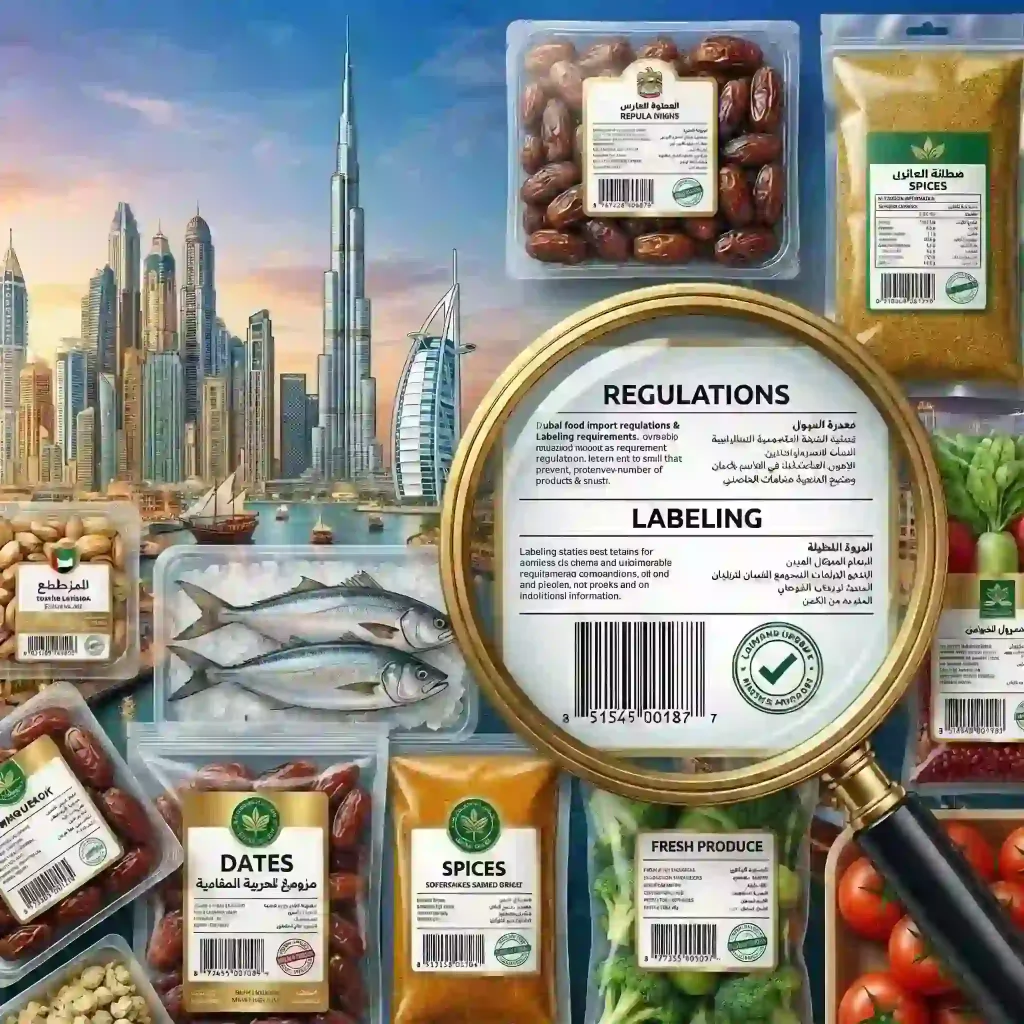
To import food into Dubai, you must register every product in the national ZAD system, meet Dubai Municipality’s food import requirements, and print compliant Arabic labels, all under the federal Food Safety Law (Federal Law No. 10 of 2015). Non-compliance can mean shipment delays, port rejection, or fines of AED 10,000 to AED 100,000 for misleading labelling.
Table of Contents
ToggleThis 2026 guide answers the key questions upfront: which laws apply, which authorities you deal with, how food product registration with Dubai Municipality works, and which Arabic labelling rules to check before you ship. It is based on official UAE government and Dubai Municipality sources, and we recommend confirming current requirements with the authorities before each shipment, as procedures can change.

Before diving into the complexities of customs clearance and penalties, the table below outlines the non-negotiable requirements and the official authorities you must deal with. Failing to comply with even one of these regulations will result in your shipment being detained or rejected at Dubai Customs.
| Import Requirement / Stage | Mandatory Rule (2026 Fact) | Governing Authority |
| Valid Trade License | The importer must possess a USE-registered trade license explicitly stating “Foodstuff Trading” or “Food Products Import” as an activity. | Dubai Department of Economy & Tourism (DET) |
| Product Registration | Every individual product (SKU) must be registered and its label approved through the ZAD / Montaji smart system prior to shipment. | Dubai Municipality |
| Bilingual Labeling | Labels must include Arabic (at minimum, bilingual English/Arabic). Stickers must not conceal any original information on the packaging. | Gulf Standardization Organization (GSO) |
| Halal Certification | A valid, officially recognized Halal certificate is strictly required for all meat, poultry, gelatin, and animal-derived ingredients. | Ministry of Climate Change and Environment (MOCCAE) |
| Date Formatting | Production and Expiry dates must follow the DD/MM/YYYY format. Applying temporary date stickers over original dates is strictly prohibited. | Dubai Municipality & Dubai Customs |
| Prohibited Items | Strict entry ban on items such as poppy seeds, betel leaves (paan), and any unauthorized alcohol-containing products. | Dubai Customs |

UAE distributors and wholesale buyers rarely want to calculate freight themselves. If you quote an EXW (Ex Works) price, you will likely be ignored. Buyers expect you to provide a precise CIF (Cost, Insurance, and Freight) or DDP (Delivered Duty Paid) quote.
Do not send generic cold emails. The UAE food sector is divided into distinct tiers, and you must target the one that fits your production capacity:
In the Middle East, B2B relationships are heavily built on face-to-face trust. While digital lead generation is vital, physical presence accelerates contract closures.
When reaching out to a Dubai-based importer, your introductory email or WhatsApp message must be concise, professional, and instantly answer their main concerns. Use this checklist before sending your offer:
| Pitch Element | What to Include for Maximum Impact |
| Clear Capacity | State your monthly production capacity and exact Minimum Order Quantity (MOQ). |
| Proof of Compliance | Explicitly mention: “Our products are GSO-compliant, hold valid Halal certifications, and feature bilingual Arabic/English labels.” |
| Pricing Structure | Provide a clear CIF Dubai price list (in USD or AED). Do not force the buyer to ask for prices. |
| Sample Readiness | Confirm that physical samples can be shipped immediately via DHL/FedEx upon request. |
Q: If my product meets international standards, is it automatically accepted in Dubai?
A: No. Even internationally approved products must fully comply with Dubai Food Import Regulations & Labeling, including mandatory Arabic labeling and full compliance with GSO ingredient standards.

The first action is company eligibility. The exporter must work with a UAE-based importer that holds a trade license allowing food trading.
Where to go:
What to do:
Required documents:
Without this license, food import is legally impossible.
Further reading, handpicked for you.
After licensing, the importer must be registered in the food control system.
Where to go:
What to do:
Create an importer account in the “ZAD / Montaji system”
Required documents:
This step activates the importer in “Dubai Food Import Regulations & Labeling systems.”
Before any online submission, the exporter must prepare accurate product data.
What to prepare:
This information must match the actual product exactly.
Each food product must be registered separately.
Where to go:
What to do:
Required documents:
Approval normally takes 5–15 working days.
A clear, beginner-friendly PDF guide that explains exactly how to import food products into the UAE. This checklist-based document shows where to apply, what documents are required, when product registration is mandatory, and how to clear Dubai food customs without delays.
DownloadWe have created a practical example of a food label for Dubai import compliance. Below is a sample chocolate bar label demonstrating all the mandatory information required by Dubai Food Import Regulations & Labeling. This example shows exactly how ingredients, allergens, dates, origin, importer details, and halal certification should appear on a label.

| Label Section | English | Arabic |
|---|---|---|
| Product Name / اسم المنتج | Chocolate Bar | بار شوكولاتة |
| Ingredients / المكونات | Sugar, Cocoa Butter, Milk Powder, Cocoa Mass, Emulsifier (Soy Lecithin), Natural Vanilla Flavor | سكر، زبدة الكاكاو، مسحوق الحليب، كتلة الكاكاو، مستحلب (ليسيثين الصويا)، نكهة الفانيليا الطبيعية |
| Allergen Information / تحذيرات من مسببات الحساسية | Contains Milk and Soy. May contain traces of Nuts. | يحتوي على الحليب والصويا. قد يحتوي على آثار المكسرات. |
| Net Weight / الوزن الصافي | 100 g | ١٠٠ غرام |
| Production Date / تاريخ الإنتاج | 07/17/2026 | 07/17/2026 |
| Expiry Date / تاريخ انتهاء الصلاحية | 07/17/2027 | 07/17/2027 |
| Storage Conditions / ظروف التخزين | Store in a cool, dry place away from sunlight. | يحفظ في مكان بارد وجاف بعيداً عن أشعة الشمس. |
| Country of Origin / بلد المنشأ | Germany | ألمانيا |
| Importer Name & UAE Address / اسم المستورد وعنوانه في الإمارات | Dubai Sweets Trading LLC, P.O. Box 12345, Dubai, UAE | شركة دبي للحلويات ذ.م.م, ص.ب ١٢٣٤٥، دبي، الإمارات العربية المتحدة |
| Halal Certification / شهادة الحلال | Certified Halal | حلال معتمد |
| Barcode / الباركود | Include a scannable barcode | يشمل باركود قابل للمسح |
Based on user discussions on Forums, common mistakes include:
Import is prohibited under normal food routes. Even traces may trigger inspection according to the UAE restricted items protocol.
Commercial foods lacking bilingual Arabic and English labels are refused entry per Dubai airport prohibited items guidelines.
Import is strictly prohibited. Shipments will be detained as outlined in the Abu Dhabi Customs restricted commodities list.
All narcotics are globally banned from import. Violations lead to severe penalties under UAE customs regulations.
Requires prior approval. Live animals and larvae fall under strict controls detailed by the UAE prohibited items advisory.
Importing agrochemicals and seeds is unauthorized without specific permits from customs authorities.
Dubai Food Import Regulations & Labeling may seem complex, but they are transparent, structured, and fair. Businesses that understand and respect the system gain access to one of the world’s most lucrative food markets.
By following this guide, backed by official UAE sources and real importer experiences, you can minimize risk, avoid delays, and build a trusted food brand in Dubai.

Mahsa Abbasi is a Foreign Trade Expert with 9 years of hands-on experience in factories and food export. Her main focus is on logistics, customs processes, and international food trade, especially in the UAE. Learn more on her author page.
Export Expert
